
ZeroTrace Proxy
Desktop proxy workflow suite for extraction, checking, benchmarking, leak testing, chains, rotation, pools, and runtime traffic.
ZeroTrace Proxy is a desktop workspace for building, testing, cleaning, and operating proxy lists. It brings the full workflow into one app: collect sources, extract proxy candidates, validate them, benchmark speed, inspect leak signals, discover working chains, save reusable pools, and run local proxy endpoints for chained or rotating traffic.
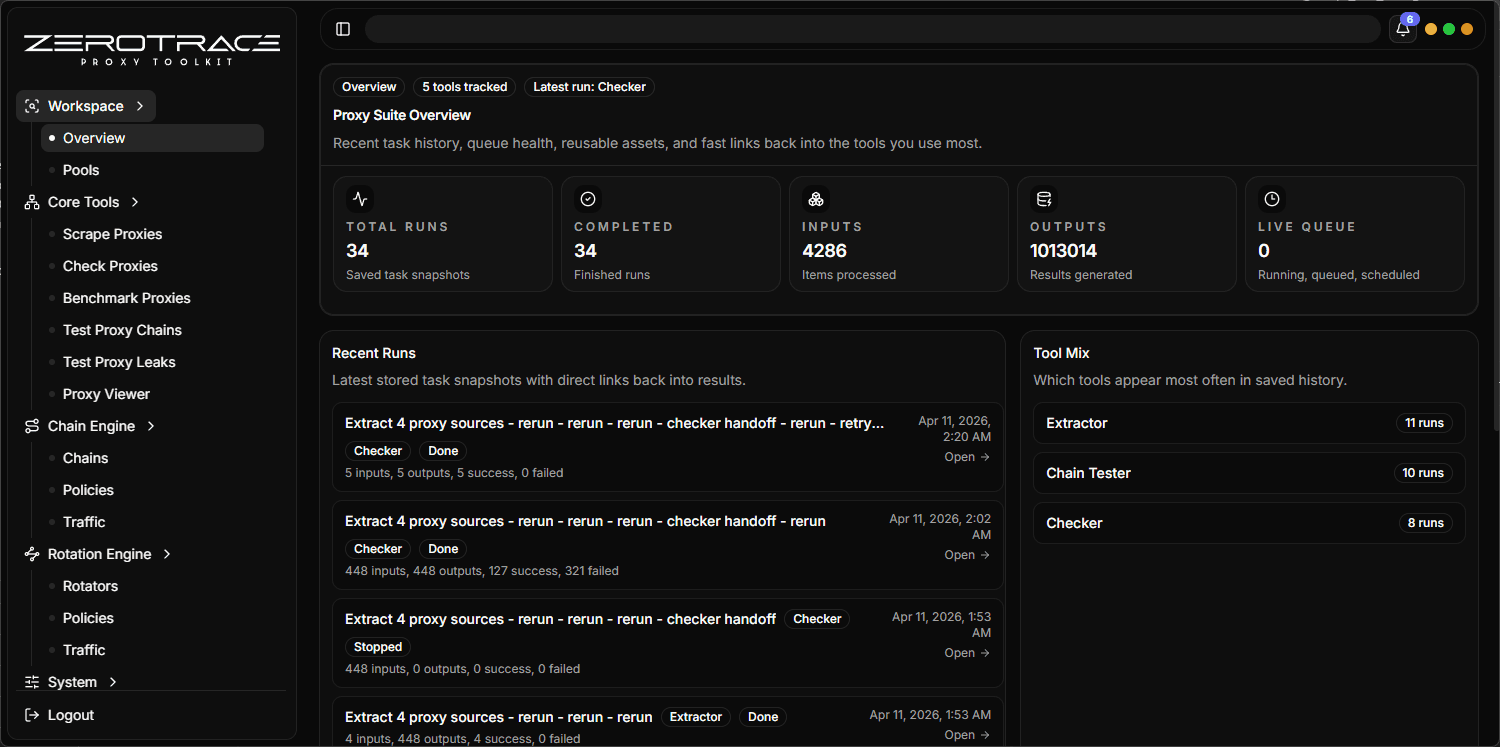
ZeroTrace Proxy is best understood as a proxy workflow suite. It is not only a checker, not only a rotator, and not an OS-wide proxifier.
What You Can Do
| Area | What it helps with |
|---|---|
| Scrape Proxies | Pull proxies from URLs, HTML pages, JSON feeds, text files, or pasted lists. |
| Check Proxies | Detect protocol, liveness, latency, HTTPS support, exit IP, anonymity, network type, ASN, ISP, and country. |
| Benchmark Proxies | Run repeated checks and calculate pass rate, best latency, average latency, and stability. |
| Test Proxy Leaks | Detect forwarding headers, proxy authorization exposure, origin mismatch, and anonymity risk. |
| Test Proxy Chains | Validate multi-hop chains with per-hop protocol support, latency, scoring, and grades. |
| Proxy Viewer | Send a single request through a proxy and inspect response body, headers, redirects, exit IP, and attempts. |
| Proxy Pools | Save working proxies into reusable collections with tags and source metadata. |
| Chain Engine | Run a local HTTP/CONNECT proxy that routes traffic through saved chains with health and fallback policies. |
| Rotation Engine | Run a local HTTP/CONNECT proxy that rotates across pool-backed or inline proxy sources. |
Tiny Features That Matter
| Category | Small but useful details |
|---|---|
| Extraction | HTML selectors, JSON paths, proxy-shaped object inference, script inspection, decompression, redirect control, headers, cookies, parser fallback, source metrics, and prefer-strongest dedupe. |
| Checking | Auto protocol detection, SOCKS-first port hints, HTTP/HTTPS probes, expected status code lists, anonymity labels, auth signals, IP enrichment fallback, network type confidence, and quality scoring. |
| Benchmarking | Multi-round checks, pass/fail counts, success rate, best/average/worst latency, best successful sample selection, and all-fail error preservation. |
| Leak testing | Via, Forwarded, X-Forwarded-For, Proxy-Authorization, origin mismatch, leak signal sorting, leak counts, and elite/anonymous/transparent classification. |
| Chain testing | HTTP CONNECT, HTTPS CONNECT, SOCKS4, SOCKS4a, SOCKS5, SOCKS5 auth, per-hop probes, per-hop errors, A-F grades, and autonomous harmony search. |
| Chain runtime | Local 127.0.0.1 HTTP/CONNECT endpoint, fallback graph validation, health loop, degraded state, Basic proxy auth, bandwidth cap, port fallback, byte counters, and 500-entry traffic log. |
| Rotation runtime | Pool and inline sources, round robin/random/least-recently-used strategies, sticky target-host sessions, rotate-on status codes, cooldown, quarantine, fallback, retry budget, per-proxy concurrency, and traffic decisions. |
| Workspace | 100-pool limit, source metadata merge, smart tags, task history cap, profile defaults, notifications, Discord payload limits, export preview, and visible storage paths. |
For a deeper lookup page, keep Detailed Feature Guide open beside the app.
Most Unique Capabilities
| Unique feature | Why it is unusual |
|---|---|
| Autonomous chain harmony | Searches candidate multi-hop chains instead of only testing chains you manually define. |
| Dual local runtimes | Separate chain and rotation engines both expose local proxy endpoints with policy, health, fallback, counters, and traffic logs. |
| Structured source parsing | HTML, JSON, text, object inference, selectors, JSON paths, decompression, and dedupe policies in the same extractor. |
| Session-aware rotation | Rotates by request count, session age, bytes, status code, cooldown/quarantine state, target-host stickiness, and concurrency. |
| Operational memory | Pools, task profiles, history, notifications, exports, Discord reporting, and runtime traffic logs keep proxy work reusable. |
Recommended Learning Path
- Start with Quickstart.
- Read App Workspace to understand navigation, task history, and pools.
- Follow Extract and Check Proxies.
- Save candidates with Build a Quality Pool.
- Move into Benchmark and Leak Test.
- Learn runtime operation through Run a Chain Runtime and Run a Rotation Runtime.
Core Concepts
- Task: A one-time job such as extracting, checking, benchmarking, testing leaks, or testing chains.
- Pool: A reusable saved collection of proxy entries with tags and source metadata.
- Profile: A saved task setup that can be reused or made the default for a tool.
- Chain: A saved ordered set of proxy hops used by the Chain Engine.
- Rotator: A saved source list and strategy used by the Rotation Engine.
- Policy: Runtime rules for health checks, timeouts, fallback, sessions, rotation, or bandwidth.
- Runtime: A local HTTP/CONNECT proxy endpoint bound to
127.0.0.1.
For a fast first win, scrape or paste a list, check it, save only alive HTTPS-capable proxies to a pool, then benchmark and leak-test that pool.